Thoughts on Success
An extract from practice-based research exploring directing for circus

This short essay extracts one of the key ideas from my recent practice-based research paper ‘Directing for Circus’, which was written as part of my Masters in Cultural Leadership at NIDA. The main research outcome in this excerpt is the concluding statement, which proposes a description of the social value of art, and considers the role that circus can play in furthering these ethical goals. If you have questions, or would like to articulate a different concept of success that works for you – please leave me a comment below!
On a different note, I also have a small fundraiser going at the moment to help me attend the World Summit on Arts and Culture in South Korea. If you enjoy reading this piece, please consider making a donation to help me on this self-funded research trip!
https://www.gofundme.com/f/attend-the-world-summit-on-arts-and-culture-in-south-korea
As a director I am primarily interested in artform development within contemporary circus. To pursue experimental creativity, practitioners must take artistic risks - but importantly they also need a framework to determine what the success of their explorations will look like. These cannot simply be personal statements of subjective goal fulfilment – the concept of success needs to respond to and have some impact on the world to be meaningful. A method of describing success should also be useful for things that artists do, such as writing grant applications, attempting to influence cultural policy and discussing their work within broader political debates.
If success is only measured through the paradigm of a market economy, then these possibilities are reduced. Circus has a unique ability to connect with audiences because of its kinaesthetic effect that brings us to the edge of our seats - but an obsession with popular appeal expressed through ticket sales can also be our downfall. Artists need tools to articulate what success looks like outside of this paradigm, so that we can support creative risk taking with solid arguments about the social value of performance.
Strategically framing success as a subjective metric can be an effective technique of mental well-being for artists, because ‘success is something that you can give to yourself’ (Jones, 2020). Time and again I have observed circus artists tie their self-worth to career prospects, linking their self-esteem to how many gigs they have. During the Covid-19 pandemic and Victorian lockdowns, I was forced to confront how this quantitative and materialistic theory of value leads to a psychologically dangerous dead end. Chasing success through external validation (such as applause) means that it can never truly be enjoyed - as the validation is temporary, while our need remains constant. To challenge this, and the effect it has on the mental health of artists, requires deep personal reflection and community support for vulnerability and self-doubt. However, it also necessitates that we critique the dominant concept of success presented to us by the market economy in which we operate – and begin to replace it with one that is informed by a philosophical concept of art’s social value.
Developing an anti-materialist conception of success is therefore an essential first step towards better mental health for artists. I am going to use Antonio Gramsci’s theory of cultural hegemony to critique how conventional models of success can lead to ‘the reproduction of capitalist social relations’ (Nantsou, 2023, 44) and their negative psychological consequences, particularly when ‘success in art … is measured by box-office takings, bums on seats’ (Archer, 2005, 40). I will then provide a brief outline of an alternative conception of art’s social value, which can be used as a north star to orient the mission of the creative risk taker.
Antonio Gramsci was an Italian communist philosopher, who was imprisoned by fascist dictator Benito Mussolini between 1926 – 1937. While held as a political prisoner, he wrote several influential works of philosophy that expanded on the ideas of Karl Marx to show how the authority of state control can be deployed in ways that do not require physical force or violence. In classical Marxism ‘the state’ refers to the political apparatus of a society, including its government, legal system and the institutions through which it can use violence to control behaviour, such as the police, prisons and the army.
Gramsci developed these ideas to distinguish different areas of social activity that reinforce the concentration of power in the hands of political elites. While economic production remains the base driver of power relations, above this are ‘two spheres of social activity: civil society, that is, social interests and relations; and political society’ (Nantsou, 2023, 43). Although politics groups organise to control forms of coercive force in society, it is civil society which creates ‘the marketplace of ideas,’ where groups such as schools, churches, media outlets and artists can ‘contribute in molecular fashion to the formation of social and political consciousness’ (Bates, 1975, 353). It is obviously in the interests of the powerful that this mass consciousness reproduces ideas which reinforce and protect the power of the political elite. This phenomenon is called cultural hegemony.
As Gramsci observed, in a society where the ruling class deploys cultural hegemony effectively, the use of coercive force becomes less frequent. The homogenisation of thought ensures that ‘consent of the led … is secured by the diffusion and popularization of the worldview of the ruling class’ (Bates, 1975, 352). This renders alternatives not only unlikely but in many cases actually unthinkable (Fisher, 2009). Challenging mainstream thought in the ways that we do our artistic practices then, is of vital importance.
In the context of contemporary Australian cultural policy, this worldview is experienced as an ‘economic rationalist paradigm’ (Hands, 2021, 445) that creates a ‘disincentive for artists to take creative risks in the light of the imperative to achieve market-driven objectives’ (Glow and Johanson, 2008, 263) such as ticket sales. Compounded by a cost of living crisis, ‘tough times have encouraged (circus) artists to play it safe and aim always for ‘success’ as defined by existing models’ (City People, 2023, 13).
These models sometimes include critical acclaim as a bulwark against financial failure, meaning that success is identified with a good review that enhances an artist’s public reputation even in the face of poor ticket sales. This also is problematic if we are seeking a counter-hegemonic model. A monopolised media environment filters potential challenges through the ‘internalization of priorities and definitions of news-worthiness that conform to the institution's policy’ (Herman and Chomsky, 2021, 7). Indeed, ‘the more an arts practice is accepted by powerful members of society, the less important it is culturally’ (Caust, 2024, 45). In summary, through promoting the conventional model of success which treats art as a commodity, cultural hegemony creates powerful constraints on artistic expression, which can make 'communities adapt their practices to meet external expectations and market demands' (Moreno Mujica and International Federation of Arts Councils and Culture Agencies, 2024).
I am far from the first circus artist to tackle the challenges of conventional thinking, and the problem itself is linked to the lineage of how contemporary circus calls into question ‘existing orthodoxies’ and embraces ‘the spirit of contestation … (as) a driving force’ (Lavers, Leroux and Burtt, 2020, p. 62). In this vein circus artist Simon Yates describes the pursuit of conventional success as ‘empire building … that leads to monocultures. To contribute to diversity is rebellion … if we have provided a glimpse of the existence and value of possibilities outside of the dominant model, it will have been a real success’ (Lavers, Leroux and Burtt, 2020, p. 198).
This Gramscian critique makes it clear that in order to encourage creative risk taking and art form development, it is vital to create an alternative model of success which frees artists from commercial expectations and replaces them with an understanding of art’s social value. Artists who can articulate the goals of their work, framed by what they want their art to contribute to society, can then create methods for evaluating and demonstrating its qualitative impact (which is something that my research will continue to explore in the future).
For my work, in order to reflect the reality of embodied and interwoven social communities, a counter-hegemonic model must also foreground the importance of other voices speaking about an artistic event. An important dimension of measuring success therefore is to consider and demonstrate how the work has affected those who engaged with it. Here then, in conclusion, is a working definition for how contemporary circus practice can be philosophically positioned, in order to encourage new definitions of success.
It is my view that art’s social function is to create empathy and broaden perspectives through encouraging audiences towards an increased awareness of their own emotions, including those that arise in response to a compelling performances. Circus has a unique effect on audiences through the creation of kinaesthetic physical responses to on-stage action. It is also simple to understand because it plays with the basic relationships that govern all of our bodies, like gravity, balance, speed and cooperation with others. When these aspects of circus are used artistically, i.e., for reasons other than the creation of commercial spectacle, circus can provide general audiences with cathartic theatrical experiences that create strong emotions. By using dramaturgy and direction as key theatrical tools, contemporary circus artists can make work that experiments with genre and form, while containing physical content that encourages reflection, compassion and dialogue as social values.
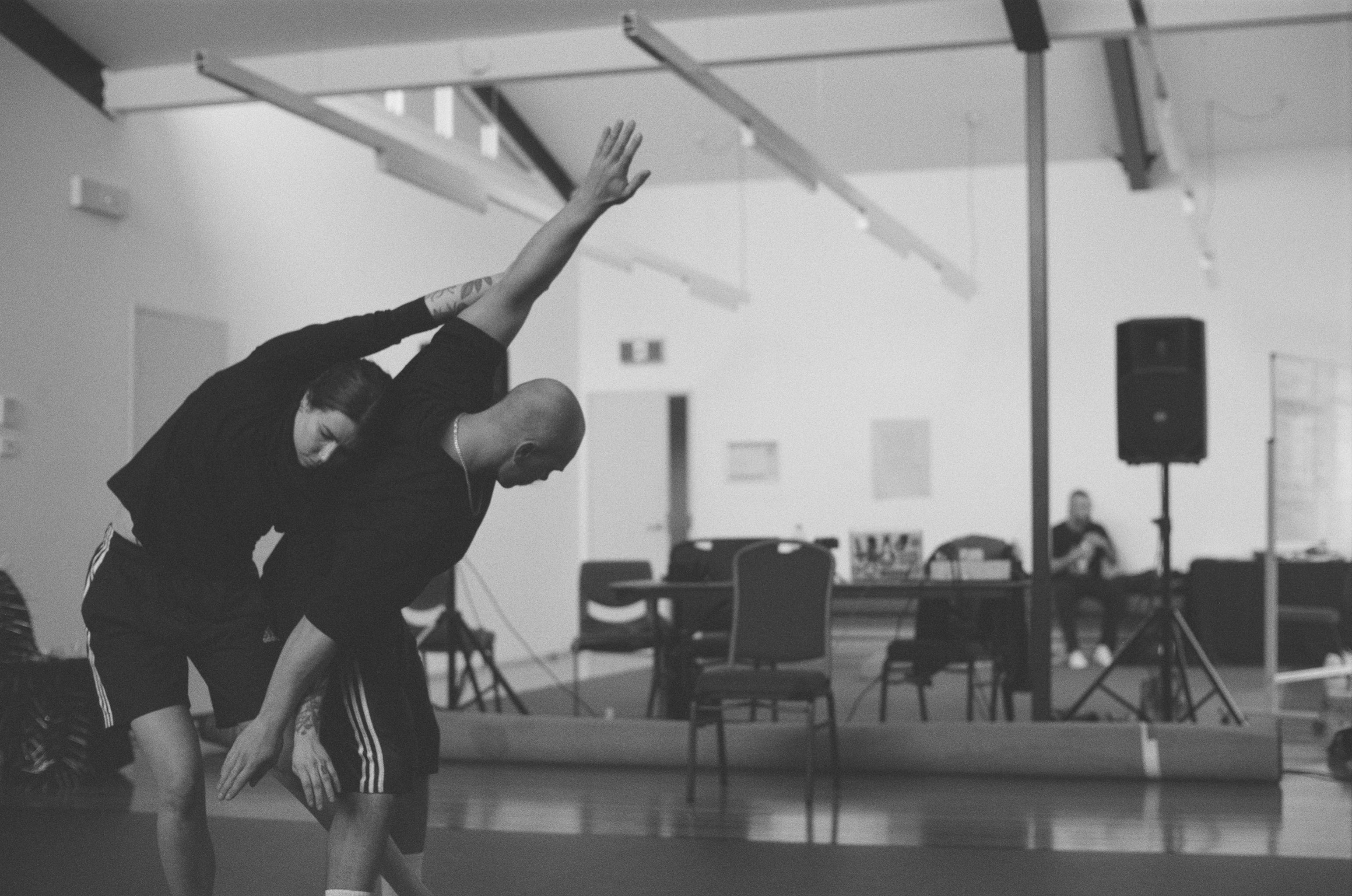
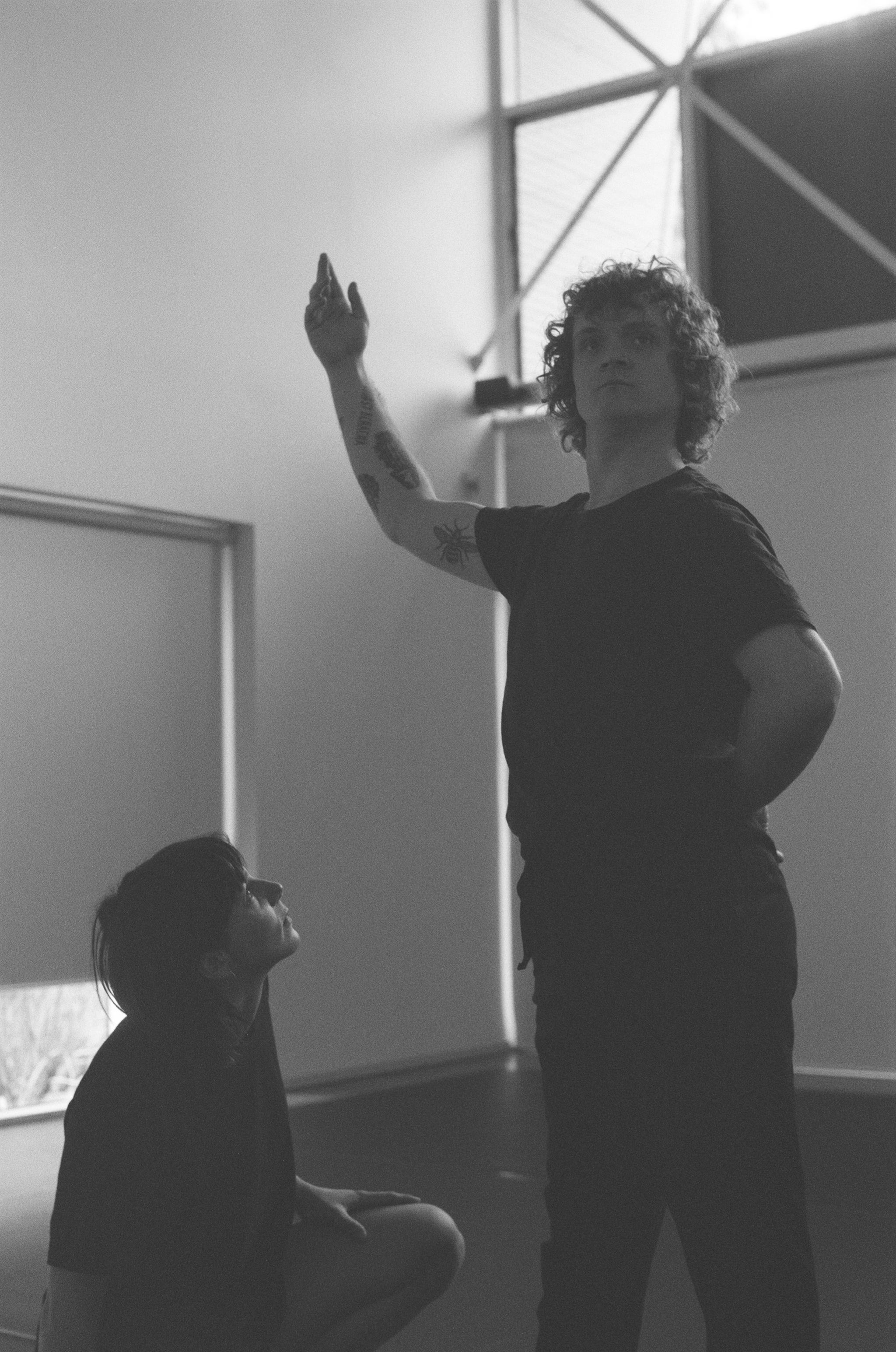
Photographs used above were taken by me on a 1969 Nikormat SLR, during the rehearsals for Apocrypha in October 2024. The performers pictured are Rindi Harridine, Adam Malone, Chloe Fazikas and Kyall Shanks.
Works Cited
Archer, R. (2005) ‘The myth of the mainstream: Politics and the performing arts in Australia today’, Platform Papers, (4), p. [i].
Bates, T.R. (1975) ‘Gramsci and the Theory of Hegemony’, Journal of the History of Ideas, 36(2), p. 351. Available at: https://doi.org/10.2307/2708933.
Caust, J. (2024) Art and politics: government and the arts in Australia: a historical and critical analysis. Abingdon, Oxon: Routledge. Available at: https://doi.org/10.4324/9781003190424.
City People (2023) CAPT Scan: A scan of the circus and physical theatre sector in Victoria. Creative Australia. Available at: https://creative.gov.au/advocacy-and-research/a-scan-of-the-circus-and-physical-theatre-sector-in-victoria/.
Fisher, M. (2009) Capitalist realism: Is there no alternative? Winchester: Zero Books.
Glow, H. and Johanson, K. (2008) ‘Looking for cultural value: Critiques of Australian cultural policy’, Asia Pacific Journal of Arts and Cultural Management, 4(2), pp. 259–269.
Hands, K. (2021) ‘Too big to fail: rethinking the foundations of Australia’s performing arts policies’, International Journal of Cultural Policy, 27(4), pp. 437–448. Available at: https://doi.org/10.1080/10286632.2020.1786079.
Herman, E.S. and Chomsky, N. (2021) ‘Manufacturing consent’, in Power and inequality. Routledge, pp. 198–206.
Jones, M. (2020) ‘What is Success’, Fluke, 1(1), pp. 30–31.
Lavers, K., Leroux, L.P. and Burtt, J. (eds) (2020) Contemporary circus / [selected and edited by] Katie Lavers, Louis Patrick Leroux, and John Burtt.
Moreno Mujica, M. and International Federation of Arts Councils and Culture Agencies (eds) (2024) Culture as a public good: navigating its role in policy debates. 1st edition. Sydney: International Federation of Arts Councils and Culture Agencies.
Nantsou, I. (2023) ‘Cultural Policy and the Integral State: A Gramscian Analysis of Arts Funding’, Performance Paradigm, 0(18), pp. 41–59.
A valuable article as we look towards better social models and the role artists can play in expressing the desires of greater humanity. As you say, “create empathy and broaden perspectives.”